Shostakovich cycle

Musical monuments

We are celebrating the Shostakovich Year 2O25 with a cycle of his complete string quartets. After opening last season with No. 1 to 9, No. 10 to 15 now follow, documenting in a special way the symbiotic relationship that composer and interpreter can form.

Ulrike Thiele

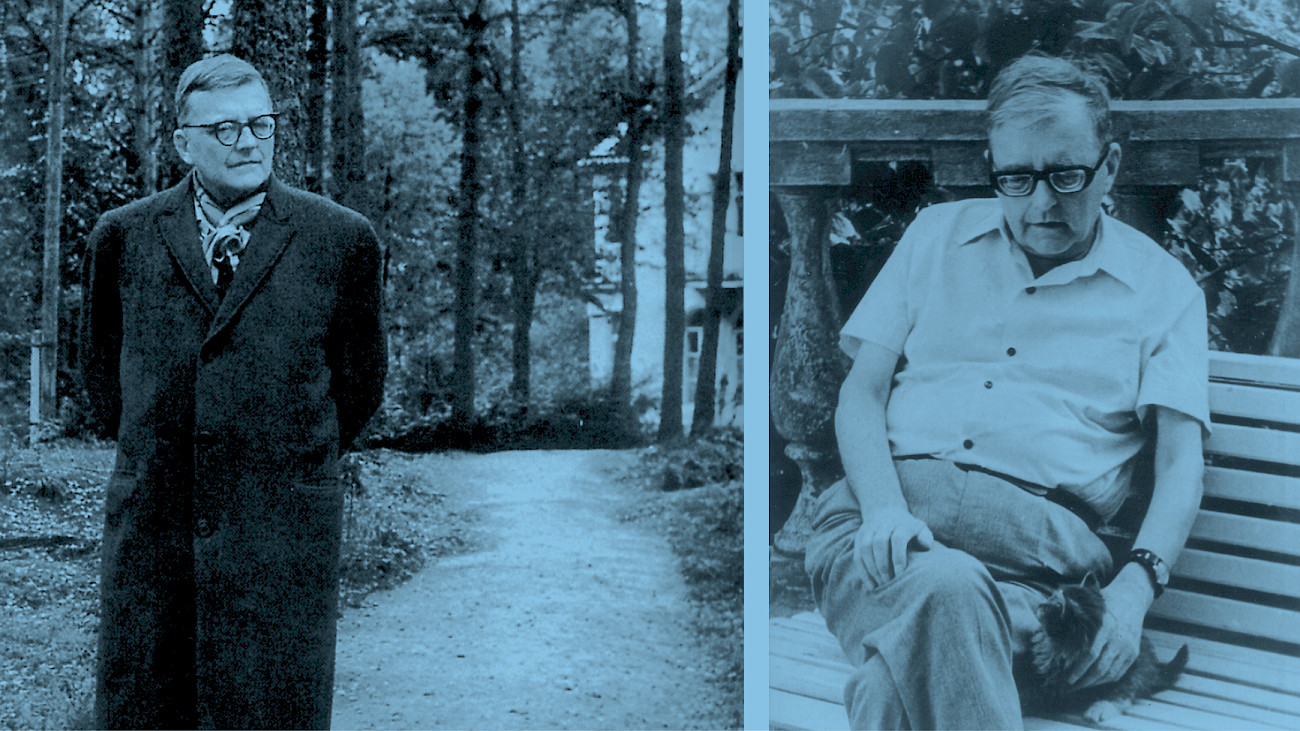
Dmitri Shostakovich (1906-1975) wrote 15 symphonies and 15 string quartets: while the symphonies repeatedly attracted the critical eye of the censors, he was able to play more freely in his string quartets. This gave him the opportunity to experiment until the end of his life. He also created eternal monuments to his ideal quartet, which still touch and shake us deeply today in his personal language.

String Quartet No. 10

The Moscow Beethoven Quartet performed No. 10 for the first time in the same concert as String Quartet No. 9 on 20 November 1964. It is dedicated to the younger composer colleague and companion Mieczysław Weinberg (1919-1996, also known as Moissej Wainberg), whose works have been undergoing a major rediscovery in recent years. Weinberg had already written nine quartets - and so Shostakovich felt challenged in a friendly competition: "I had set myself the task of catching up with and overtaking Wainberg, which I have now done." There is also a musical reference to the personal connection between the two composers: the second movement, the "Allegretto furioso", is strongly reminiscent of the so-called "Stalin movement" from Shostakovich's Symphony No. 10 in its hammering, insistent gesture. It had triggered the biggest debates since "Lady Macbeth of Mtsensk", with discussions lasting several days even being organised for it - and Weinberg publicly declared his support for Shostakovich in this polemic field of tension. This was anything but a matter of course under these political and social circumstances.

String Quartet No. 11

In August 1965, Shostakovich received the news that the second violinist of the Beethoven Quartet, Vasily Zhirinsky, had died. He then said to primarius Dmitri Zyganov: "We are all leaving this world. (...) But the Beethoven Quartet should exist forever. In 50 years and also in 100 years." The ensemble, which was a kind of ideal ensemble for the composer, had premièred all of his string quartets since the second. In a jam-packed year 1966, in which his 60th birthday was celebrated worldwide with numerous special events (including Leonard Bernstein conducting Shostakovich's Ninth Symphony at New York's Lincoln Center), the composer took time in February 1966 to honour the violinist with String Quartet No. 11. The special structure alone pays tribute to the loss, as the quartet performs as a trio for long stretches - someone is missing. The chorale allusion in the recitative and the elegy are central moments of mourning. In addition, the "morendo" in pianissimo at the end of each of the seven sections of the suite repeatedly lends the character of farewell. The composer placed the motto motif, which is presented in the introduction, in the hands of his brother, Sergei Shirinsky.

String Quartet No. 12

Shostakovich dedicated the following quartets to the other members of the Beethoven Quartet: the 12th to first violinist Dmitri Zyganov, the 13th to violist Vadim Borissovsky and the 14th and 15th to cellist Sergei Zhirinsky. After serious health setbacks, he hoped to be able to return to his old vigour in 1968. The twelfth quartet bears witness to this spirit of optimism, consistently continuing the echoes of new tonal experiments already recognisable in the eleventh quartet. The introductory motif is already twelve-tone in structure and without repetition - although he by no means dispensed with tonal associations in what follows. The second, complex movement brings Shostakovich's idea of large-scale form to life. When the dedicatee Zyganov asked whether the new work was chamber music in nature, the composer replied: "No, no, it's a symphony, a symphony."

String Quartet No. 13

As if in waves, Shostakovich's life alternated between phases of enormous health setbacks and hopeful creative periods. He tried to get the increasing muscle weakness in his limbs, which was caused by chronic inflammation of the spinal cord, under control with the help of a strict medical treatment plan. "I even started playing the piano, not just slowly and quietly, but also quickly and loudly. For example, the fourth, fifth and some other etudes by Chopin," he reported from the clinic. As soon as his condition improved, he set about composing. With the 13th string quartet, he continued along the same path: he once again utilised the means of dodecaphony, but combined them with strong expressive gestures. For example, the viola, the instrument of the dedicatee Wadim Borissowski, begins three times as a soloist before unfolding its twelve-tone lament. It is the centrepiece of the one-movement work, which sets shock to music.

String Quartet No. 14

The fact that Quartet No. 14, composed in 1973, is dedicated to the cello becomes clear as soon as the cello introduces the dance-like main theme. The two cheerful outer movements surround the Adagio, which features a touching duet between the first violin and cello. Similar to the 11th Quartet with its trio passages, Shostakovich wrote the disappearance of his esteemed Beethoven Quartet into the work: After the death of Wadim Borissowski, only two of the musician friends were still alive. Another cipher is one of his favourite devices: he quotes himself. With the aria "Seryozha, my beloved" from the opera "Lady Macbeth of Mtsensk", he addresses the dedicatee Sergei Zhirinsky in coded form, i.e. in the most personal way possible. However, there was something fateful about these dedications - Shostakovich was aware of this: "I don't want any more dedications. When I dedicated the 13th Quartet to Borissowski, my friend died shortly afterwards. Death is circling around me, taking away one after the other, people close and dear to me, colleagues from my youth." Tragically, he was proved right.

String Quartet No. 15

in 1974, Shostakovich set to work on his next string quartet - he had already revealed his actual goal to the violinist of the Beethoven Quartet, Dmitri Zyganov, years earlier: It was to be a cycle of 24 string quartets, through all keys, very similar to his 24 preludes modelled on Bach. But the loss was omnipresent - the loss of his own strength and the loss of important companions. And even without a dedication at the beginning, it was clear that the latest string quartet was to be a resounding epitaph: a single 35-minute funeral dirge consisting of six seamlessly merging movements. Each one an adagio. There is no room for cheerfulness here. The Beethoven Quartet was, of course, scheduled for the premiere. The cellist Sergej Schirinski had apparently recovered from a serious heart attack in time for the start of the first rehearsals. However, he then suffered a relapse and died before the quartet could be premièred. As a result, the young Taneyev Quartet had to take over the first performance on 15 November 1974, at which Shostakovich was still present, although he was already severely ill. "When the last chords of the quartet died away quietly, the hall fell completely silent and everyone stood up in silence to pay their respects to the composer," reported a contemporary. "Afterwards, a never-ending storm of applause broke out." Even though his health deteriorated from day to day, Shostakovich did not give up composing. He told Dmitri Zyganov, the last remaining member of the Beethoven quartet, that he had decided to write the 16th string quartet. However, he added sadly: "You know, Mitja, I won't be able to finish the 24 quartets I promised you ...". Shostakovich died in August 1975 - the 15 quartets were to remain.
November 2025
Sun 30. Nov
17.00

Shostakovich cycle

Jerusalem Quartet, Alexander Pavlovsky Violine, Sergei Bresler Violine, Alexander Gordon Viola, Kyril Zlotnikov Violoncello Schostakowitsch
Sat 29. Nov
18.30

Shostakovich cycle

Jerusalem Quartet, Alexander Pavlovsky Violine, Sergei Bresler Violine, Alexander Gordon Viola, Kyril Zlotnikov Violoncello Schostakowitsch
published: 12.11.2025

Tags