"That went straight to the heart!"
Quotes from contemporaries make it clear why Mozart and Liszt are counted among the "best pianists of all time".
In October, Turkish pianist Fazıl Say will perform Wolfgang Amadeus Mozart's Piano Concerto No. 21. In December, another keyboard virtuoso will be a guest: Simon Trpčeski from North Macedonia will perform Franz Liszt's Piano Concerto No. 2. A special choice: the two piano luminaries will present works by composers who are counted among the "best pianists of all time".
Comparing the playing skills of musicians who lived several hundred years ago with those of today seems a little far-fetched: While we can simply compare recordings and concert experiences of our current stars, we have to rely on written records of the piano virtuosos of the past. In some cases, however, these are so exuberant that even long-dead greats have made it onto the best lists - like Mozart and Liszt. Both developed from "child prodigies" to superstars. And not just because of their compositions, but especially because of their dexterity, as the testimonies presented on the following double page make clear.
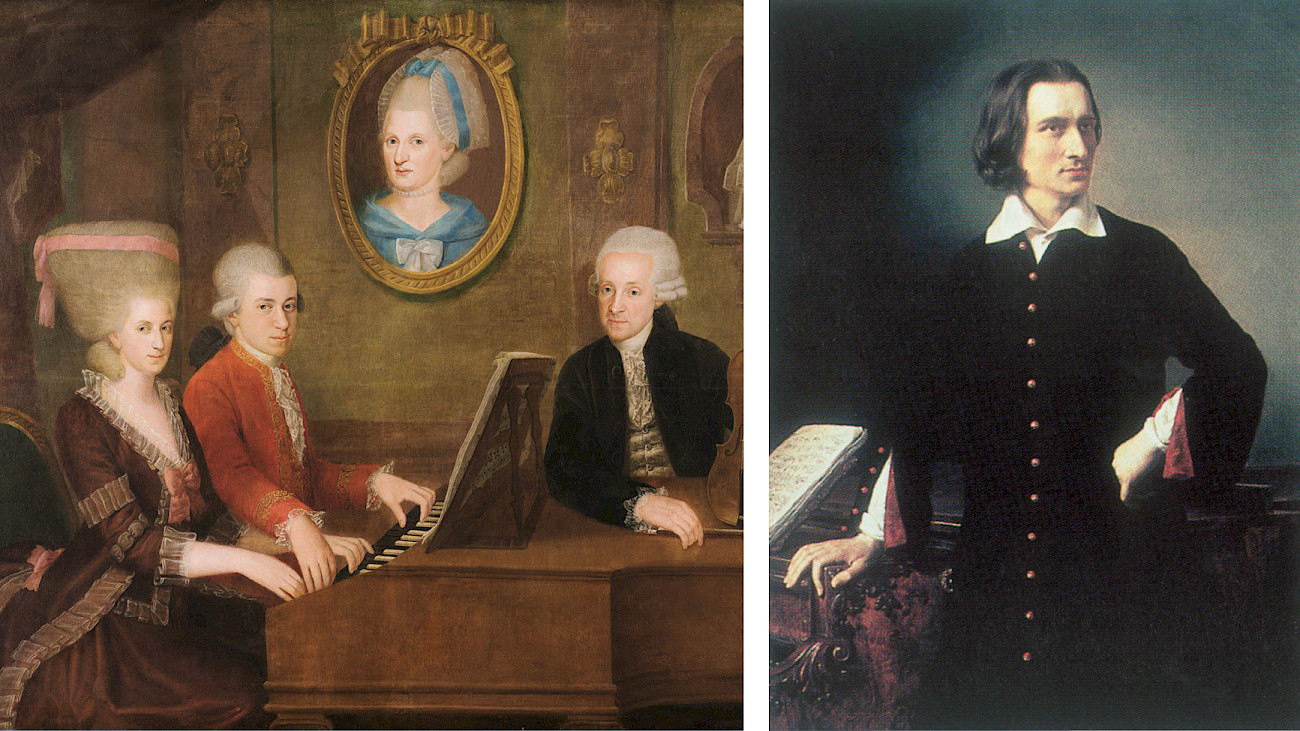
Wolfgang Amadeus Mozart, 1756-1791
"I know nothing at all about exercising on the piano as he once did for over 7 years, because his exercising consisted of always having to let himself be heard, that he was always presented with things that he had to play from sheet music, and this was his exercising."
Maria Anna "Nannerl" Mozart (1751-1829) - Mozart's sister about her brother's piano practising in a letter to the publisher Breitkopf & Härtel, 1792.
-
"An admirable speed, which one could call unique, especially with regard to the left hand or the bass, subtlety and delicacy, the most beautiful, eloquent expression and a feeling of which only a Mozart was capable, were the advantages of his playing, which, coupled with his wealth of thought and knowledge of the composition, naturally had to captivate every listener and elevate Mozart to the greatest pianist of his time."
Franz Xaver Niemetschek (1766-1849) - the Czech philosopher and music critic in his book "Leben des K.K. Kapellmeisters Wolfgang Gottlieb Mozart nach Originalquellen beschrieben", 1798.
-
"Until then, I had never heard anyone perform so spiritedly and gracefully. I was particularly surprised by an Adagio and several of his extemporised variations, for which the Emperor [Joseph II] chose the theme."
Muzio Clementi (1752-1832) - the Italian composer and pianist after losing a piano competition against Mozart at the Viennese court on 24 December 1781.
-
"Mozart's loss is irreplaceable; I will never forget his piano playing in my life; it touched my heart!"
Joseph Haydn (1732-1809) - recorded by the writer Georg August Griesinger in "Biographical Notes on Joseph Haydn", 1810.
-
"He plays with magical skill and reads so precisely from the page that it is hard to find his equal in this respect."
Christian Friedrich Daniel Schubart (1739-1791) - the German poet, composer and publicist in his essay "Ideen zu einer Ästhetik der Tonkunst", 1806.
Fazıl Say plays Mozart
The Turkish pianist and composer is one of the most sought-after and unconventional soloists around. He is passionate about music, mobilises 1.3 million followers on Instagram and usually plays differently than expected. Under the direction of Jan Willem de Vriend, he interprets Mozart's Piano Concerto No. 21.
Franz Liszt, 1811-1886
"Liszt is without doubt the greatest pianist of our time and of all time; it is a real revolution in this instrument. He summarises all transformations in it [...]. He is both the Paganini and the Beethoven of the piano [...]. As soon as his hands rest on the keys, inspiration seizes and occupies him. Already he no longer belongs to himself, his eyes sparkle, his heart beats, his hair starts to move and tremble, his physiognomy takes on a strange and disconcerting expression; this is no longer a human being, this is a fantastic being, this is a spirit that does not belong to our world. Then, under his fingers, in the breath of his inspiration, like roses in spring under the sun's kisses, marvellous poems bloom, soaked in tears, terrible dramas, for Liszt is a great poet."
Jean Saint-Rieul-Dupouy- the editor of the Bordeaux Volkszeitung in a report dated 13 September 1844.
-
"His marvellous fingers are capable of everything, they are means for him, but great and boundless means."
Caroline Boissier-Butini ("Madame Auguste Boissier", 1786-1836) - the Swiss pianist, composer and singer in her transcripts of her daughter's piano lessons with Liszt, published posthumously by her family in "Liszt pédagogue", 1927.
-
"Playing, he overcame difficulties with which another would break his fingers. His touch was marvellous, almost dreamlike. When he played a melody, it was as if flowers were sprouting from under his hands. He held his arms and body so still that you got the impression he wasn't playing at all, but magnetising the piano."
Felix Weingartner (1863-1942) - the Austrian conductor, composer and pianist in his "Memoirs", 1923.
-
"What we love about Franz Liszt is that he is always the same fiery, energetic artist, with tousled hair, the same musical Mazeppa, roaring through the steppes of 32nd notes on a piano without brakes; when he falls, it is to rise again as a king! In a word, he is as romantic today as he was in the past [...]. The years and experience have made him wiser. He has not listened to the advice of enlightened critics, who favourably urged him to rid himself of all his youthful gestures, and we found him as we heard him, perhaps even more astonishing [...]. Liszt is not a pianist, he is a poet, whether he plays his own music or that of others."
Théophile Gautier (1811-1872) - the French writer in an article in "La Presse", 22 April 1844.

Simon Trpčeski plays Liszt
With the group Makedonissimo and folk music from his Macedonian homeland, he thrilled Zurich audiences in 2022. As a soloist, he combines phenomenal technique with subtle, poetic interpretation. Now he will play Liszt's Piano Concerto No. 2 under the direction of Philippe Jordan.